Just a decade ago, 60 grams of carbs an hour was considered the upper end of fueling. Now it's not even the minimum in the WorldTour peloton. Here's what the world's best are actually eating to survive three weeks of racing at the Tour.
120g of carbs an hour. Zero mercy. No bonks.
The Tour is a bike race that's ultimately a test of human endurance. Winning or even surviving a three-week Grand Tour isn't merely about lung capacity, muscles and watts per kilo, it's about eating. Constantly.
Modern pro cycling has become a full-blown fueling arms race. Teams obsess over carbs, sodium, hydration, gut training, glucose transporters, sweat rates, and exactly when a rider should shove a gel into their face before detonating or worse, cramping.
How many carbs per hour do pro cyclists take in?
A decade ago, sports nutrition advice said athletes should aim for 60–90g of carbs per hour. Today's WorldTour peloton has blown straight past that.
Top riders regularly consume 120+ grams of carbohydrates per hour, especially on hard mountain stages where glycogen depletion means instant suffering. Carbs are rocket fuel. At race intensity, fat oxidation can't keep up. Your body needs glucose, and it needs it fast.
But here's where it gets nerdy, in a good way. You can't just slam pure sugar and hope for the best. Your gut can only absorb so much through a single intestinal transporter. That's why modern fueling products use multiple transportable carbohydrates, typically glucose or maltodextrin paired with fructose in ratios like 2:1 or 1:0.8. Or to put it less scientifically: More carbs in. Less GI distress. More watts out.
So what are Tour riders actually eating during a stage? Everything. As much as possible.
Early in the race, during the neutral roll-out or calmer sections, you'll see riders eating actual food: rice cakes, mini sandwiches, low-fat pastries, fruit bars, chews.
Real food gives the stomach something solid and can help prevent flavor fatigue after hour four of sweet gels. But once the race turns on, chewing is over.
When the peloton hits a decisive climb and heart rates spike north of threshold, riders switch to liquid and semi-liquid fuel. That means: high-carb drink mix, gels, chews that disappear fast. No one wants to unwrap a rice cake while climbing Alpe d'Huez at 430 watts.
A single bottle of modern super-carb mix plus a gel can deliver 80–140g of carbohydrates with almost zero chewing. That's why liquid carbs have become one of the biggest performance breakthroughs in endurance sport.
What do pro cycling teams use for fueling?
Here's what's in the bottles and jersey pockets of the world's biggest teams.
UAE Team Emirates XRG – If you want to fuel like Tadej Pogačar, think precision and relentless carb delivery. UAE leans heavily on Enervit C2:1 Gel system, perfectly engineered for dual-source carbohydrate absorption, with support from Core body-temp sensors. The Enervit formulas are engineered for aggressive fueling under brutal race loads. Translation: massive energy, minimal stomach rebellion.
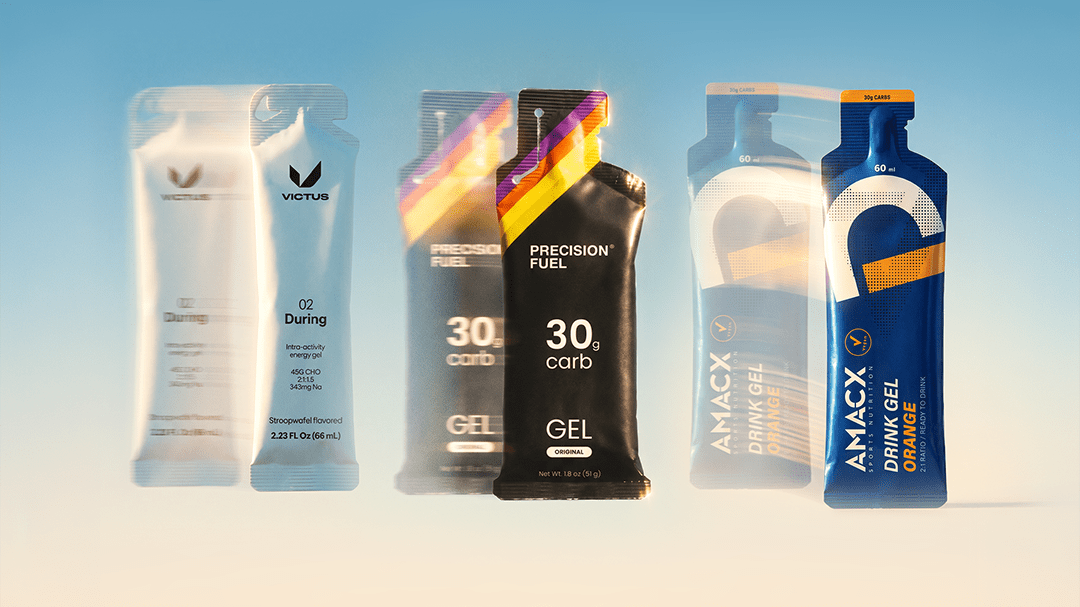
The Visma–Lease a Bike – Fuel exactly like Jonas Vingegaard. This team relies on the highly optimized line from Amacx. They'll use Amacx Turbo Gel, Amacx Turbo Chew Bars, Amacx Turbo Chews, and the mental clarity/endurance edge of Ketone-IQ. Measure everything. Fuel constantly.
Netcompany INEOS + Uno-X Mobility: Hydrogel Nation – These squads rely heavily on Maurten, famous for hydrogel technology. Maurten encapsulates carbohydrates in a pH-sensitive gel that helps shuttle carbs through the stomach with less GI distress. This is a fancy way of saying: More fuel. Less sloshing.
EF Education–EasyPost & Bahrain Victorious – Both of these dynamic rosters are entirely powered by Amacx to drive their aggressive, high-carbohydrate fueling programs. EF, however, takes things deep into the scientific weeds. They stack Core real-time body-temperature sensors and Box Altitude hypoxic altitude simulation technology directly into their performance nerd cave. This advanced setup allows sports scientists to track core thermal strain and systemic oxygen stress concurrently, ensuring riders acclimate perfectly to the expected blazing summer heat and altitude while under extreme cardiovascular loads.
The Team Picnic–PostNL & Lotto–Intermarché – These two teams leverage the dialed fueling system from Precision Fuel and Hydration. They'll use PF30 Gels, Drink Mix, and Hydration 1000 tablets throughout the race. Plus, they use OOfos recovery slides anytime they aren't pedaling. That counts for something!
Pinarello Q36.5 Pro Cycling – This tactical squad leaves nothing to chance, fueling with a mathematically calculated combination of Amacx energy products and relying heavily on Amacx Beet Shots and Amacx Cherry Juice+ for optimal recovery and nitrous-like blood flow. Plus the magic of Nomio and its broccoli sprouts for a boost. Their bike cockpits are completely integrated with the industry-standard tracking suite of Garmin head units and Core thermal sensors, giving them a highly responsive look at energy efficiency.
Tudor Pro Cycling – Other than focusing on active energy on the bike, they place massive emphasis on down-time stabilization, relying on KA-EX for post-stage systemic recovery to flush cellular waste and curb inflammation. On the open road, they stay hydrated using lightweight Elite bottles.
Lotto–Intermarché & Team Picnic–PostNL – Both programs are dialed with Precision Fuel & Hydration (PFH), turning race day nutrition into a clinical-level fueling plan. They map out highly individualized carbohydrate and sodium replacement strategies tailored to each rider's unique sweat rate. This data is vital for surviving those hot, ugly, soul-removing mountain stages where dropping even a fraction of your target sodium balance means instant cramping, a locked-up gastrointestinal tract, and an immediate DNF.
Movistar Team / Cofidis / Lidl–Trek / Groupama–FDJ United / Alpecin–Premier Tech / NSN / Jayco–AlUla / Caja Rural / TotalEnergies / Decathlon CMA CGM / Team XDS Astana Soudal / Quick-Step / Red Bull–Bora–Hansgrohe – The fundamentals don't change from team to team. Even if we don't know their nutrition playbook, riders are still chasing triple-digit carbs per hour, tracking core temperature with gear like Core sensors, and living on gels and drink mix once the racing gets hard. The names on the jersey change, but we know they're just as dialed as any other team at the Tour.
It's safe to say: nobody is out there just "eyeballing" the Tour. They're not showing up with just vibes and baguettes — it's an entirely different ball game now.