Energy chews can be a useful tool for marathon runners. Chews solve some of the fueling problems athletes face through variety in texture, flavor format, delivery, and portion size. This guide covers the best options for marathon runners, how to use them across all 26.2 miles, and where they fit in your race-day fueling plan.
Energy chews sit in a useful middle ground for marathon runners — more texture than a gel, easier to eat on the move than a bar, and simple enough to portion across a long effort without overthinking it. Most servings deliver 20 to 30 grams of carbohydrates, with caffeine and sodium options depending on the product and the brand. This guide covers the best options on The Feed, how to time them across 26.2 miles, and how they stack up against gels when you're building a race-day fueling plan.
What are energy chews and how do they work during a marathon run?
Energy chews are bite-sized gummies or soft blocks made primarily from fast-absorbing sugars, usually a glucose and fructose blend, so your gut can process carbs quickly while you run. Most servings deliver roughly 20 to 30 grams of carbohydrates, sometimes with electrolytes or caffeine depending on the product.
During a marathon, your muscles burn through stored glycogen. Once you're past 75 to 90 minutes of effort, eating carbs on the course helps delay fatigue and protect pace in the late miles. Chews release energy slightly more gradually than a thin gel because you chew and swallow. Moreover, as you chew and break down energy chews, specific receptors in your mouth act as a sophisticated warning system, immediately signaling to your brain that fuel is on its way long before it actually reaches your stomach.
Regardless, the goal is the same: keep blood glucose up and muscle glycogen topped off.
What are the best energy chews for marathon runners?
Marathon runners rate chews on taste, stomach comfort, pack size, and how easy they are to open at pace. These are the top picks on The Feed for marathon and long-distance running — all tested by endurance athletes, not just reviewed online.
1. GU Energy Chews — All-around pick
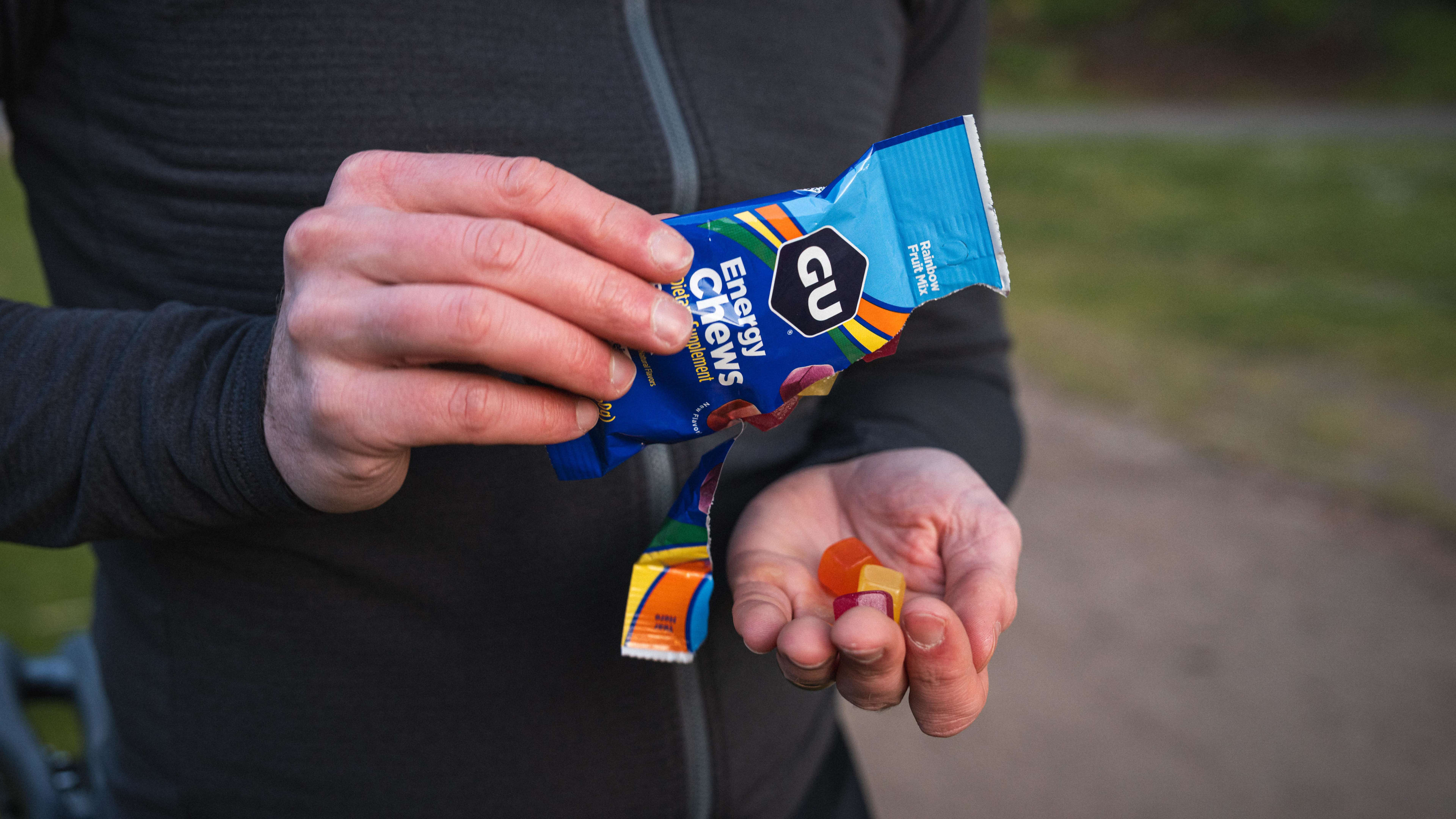
GU Energy Chews are the default for many competitive marathoners: Informed Choice certified, vegan, amino acids and electrolytes in every serving. About 100 calories, 24g carbs, 40mg sodium per serving. Caffeinated option in Strawberry at 20mg — enough for a light boost late in the race without overdoing it. Predictable texture and widely available at race expos if you need a backup.
Best for: runners who want a reliable, well-tested chew with amino acids and a light caffeine option.
2. Honey Stinger Energy Chews — Best for organic ingredients and bigger caffeine
Honey Stinger Energy Chews are built on organic honey and tapioca syrup — two carb sources that absorb quickly and tend to sit well across long efforts. A full pack is 160 calories and 39g carbs; caffeinated flavors (Berry Blast and Tropical Twist) come in at 100mg caffeine per serving. That's worth knowing before you stack with a morning coffee. USDA organic, gluten-free, dairy-free.
Best for: runners who want organic ingredients, honey-based carbs, and a high caffeine option for the back half of the race.
3. Skratch Labs Sport Energy Chews — Best for sensitive stomachs
Skratch Energy Chews use real fruit and a short ingredient list with no artificial dyes, a dual-carb blend, and a softer texture that suits runners who find most chews too sweet or too sticky. Most flavors are caffeine-free; Sour Cherry has around 50mg per serving. A reliable choice for runners who already use Skratch hydration and want consistent stomach behavior across their entire fueling plan.
Best for: runners with sensitive stomachs, anyone who hits flavor fatigue on sweeter chews, and athletes who want clean ingredients throughout race day.
4. Clif Bloks — Best for portion control
Clif Bloks are individually portioned blocks, each one is a discrete unit you can eat one at a time, which makes it easy to dial in carbs gradually without committing to a full serving at once. About 24g carbs and 70mg sodium per 3-block serving. Black Cherry and Mountain Berry carry 50mg caffeine; other flavors are caffeine-free. A strong pick for runners who want granular control over fueling, especially earlier in a build when you're still figuring out your hourly targets.
Best for: runners who want portion-by-portion control and a proven texture that holds up in heat and cold.
5. SiS Beta Fuel Chews — Best for high-carb fueling
SiS Beta Fuel Chews are designed for athletes pushing toward the higher end of hourly carb intake. Each pack delivers 45g of carbohydrates across two large blocks, more per serving than any other chew in the category, using a 1:0.8 maltodextrin-to-fructose ratio that saturates both intestinal transporters at once. That ratio matches the Beta Fuel gel and drink mix, so you can layer them to reach 80 to 120g of carbs per hour without the gastrointestinal problems that high-carb fueling typically causes. Caffeine-free, so they pair cleanly with a caffeinated gel in the final miles.
Best for: marathoners and long-course athletes already fueling at high carb volumes who want a chew format that integrates with the full Beta Fuel system.
6. Precision Fuel and Hydration PF30 Chews — Best for neutral flavor and system fueling
PF30 Chews are among the least sweet options in the category, two 15g blocks per packet available in Original or Mint and Lemon, 30g carbs total, with a 2:1 glucose-to-fructose ratio. No electrolytes are included by design; they're built to pair with the Precision Hydration range so you control carbs and sodium separately rather than bundling them. Their high carb-to-weight ratio makes them a smart choice when packing light for a race, and the neutral flavor profile holds up in the back half of a marathon when sweet options become harder to stomach.
Best for: athletes who want to separate fueling and hydration, runners sensitive to sweet flavors, and anyone already using the Precision Fuel and Hydration system.
7. Noogs Sour Energy Chews — Best for flavor fatigue
Noogs address a problem most marathon runners encounter somewhere between miles 14 and 18: sweet stops being palatable. The sour profile stays approachable when standard sweet chews become difficult to get down. Each serving contains 19g of carbs, 150mg of sodium, and 50mg of potassium, one of the stronger electrolyte profiles in this category. Caffeinated versions are available in Strawberry Lemonade and Poolside Pop, both at 50mg.
Best for: runners who hit flavor fatigue on long efforts, anyone racing in heat who needs higher sodium and potassium, and athletes who want a sour alternative to standard sweet chews.
How do energy chews compare to gels and bars?
Factor | Energy chews | Energy gels | Energy bars |
Texture | Chewable, slower eating | Smooth, fast swallow | Dense, more chewing required |
Typical carbs | ~20–30g per serving | ~20–25g per packet | ~30–45g per bar |
Best for | Steady fueling, taste variety | Quick hits, minimal chewing | Early miles or ultras |
Gut notes | Easier for some vs. thick gels | Can be sweet or sticky | Slower digestion at race pace |
Many marathoners use chews for miles 6 through 20 and gels for a fast carb hit in the final 10K, or the reverse, depending on gut preference. The winning plan is the one you practiced in training.
How should you use energy chews during a marathon?
Start your race with a carb-focused breakfast you already trust, then take your first chews before you feel depleted — usually around 30 to 45 minutes in. After that, most athletes fuel every 20 to 45 minutes, targeting 30 to 60 grams of carbs per hour depending on size, pace, and conditions.
The beginning. Start fueling before you feel like you need to, ideally within the first 20 to 30 minutes of the race. Most runners wait too long, and by the time they feel the drop, they're already behind. Target at least 60 grams of carbs per hour, with chews making that easy to portion: half a pack every 20 minutes keeps intake steady without committing to a full serving at once.
The middle miles. Roughly miles 13 through 20 are where consistency matters most. Skipping a round of chews there doesn't hurt immediately, but it shows up at mile 23. Keep your fueling intervals the same regardless of how your legs feel.
The home stretch. For the final stretch, if you've been training with caffeine, this is when to use it. A caffeinated chew around mile 20 gives it time to absorb before the finish. Take everything with water at aid stations.
A few things that make race-day execution easier: set a watch alert so fueling stays on schedule, practice opening packets at pace in training, and pre-open a few chews into a zip bag if your race allows a belt or vest. Take chews with hydration — fueling is part hydration, part carbs.
Which energy chews have the best flavor for marathon running?
Flavor is personal, but marathoners consistently gravitate toward fruit profiles — berry, orange, cherry — for less palate fatigue over hours. Sour or tart chews (Noogs, Skratch Sour Cherry) can feel refreshing in heat when sweet options start to drag. Neutral or lighter flavors help athletes who get flavor fatigue in the back half of long efforts.
Practical approach: buy a mixed selection and rank them on long runs, not on the couch. Train with the caffeinated flavor you plan to use late in the race — caffeine tastes stronger when you're tired. Filter by sour, neutral, or caffeinated at The Feed chews collection to narrow the field before you commit to a race-day stash.
What are common issues with energy chews on race day?
Most problems come down to timing and execution rather than the format itself.
Slow to eat at pace: Chews take longer than a gel when you're breathing hard. Mix in gels if you find yourself fumbling mid-effort.
Not enough fluid: Always take chews with water at aid stations.
Flavor fatigue: Rotate flavors across training runs. Don't settle on one chew for the whole race without testing it on a 20-miler first.
Stomach issues: These almost always trace back to insufficient practice, not a product problem. Run your exact race-day protocol on long training runs before committing to it.
FAQ
What are the best energy chews for marathon running? GU, Honey Stinger, Skratch, Clif Bloks, PROBAR Bolt, and Noogs are the top picks on The Feed for marathon runners. The best one is the one you trained with.
How do energy chews compare to gels for marathon running? Chews require chewing and give you more portion control; gels are faster to swallow and easier to take at high intensity. Most marathoners use both.
How should I use energy chews during a marathon? Start before you feel depleted — around 30 to 45 minutes in — then fuel every 20 to 45 minutes targeting 30 to 60 grams of carbs per hour. Always take with water.
Do energy chews have caffeine? Some do. In fact, we have a caffeine-specific guide here. GU Strawberry (20mg), Honey Stinger Berry Blast and Tropical Twist (100mg), Skratch Sour Cherry (50mg), Clif Bloks Black Cherry and Mountain Berry (50mg), and Noogs Strawberry Lemonade and Poolside Pop (50mg). Use caffeinated chews only if you've practiced with caffeine in training.
Are vegan energy chews available for marathon running? Yes — GU, Skratch, Clif Bloks, and Noogs are all vegan-friendly. Honey Stinger uses honey and is not vegan.