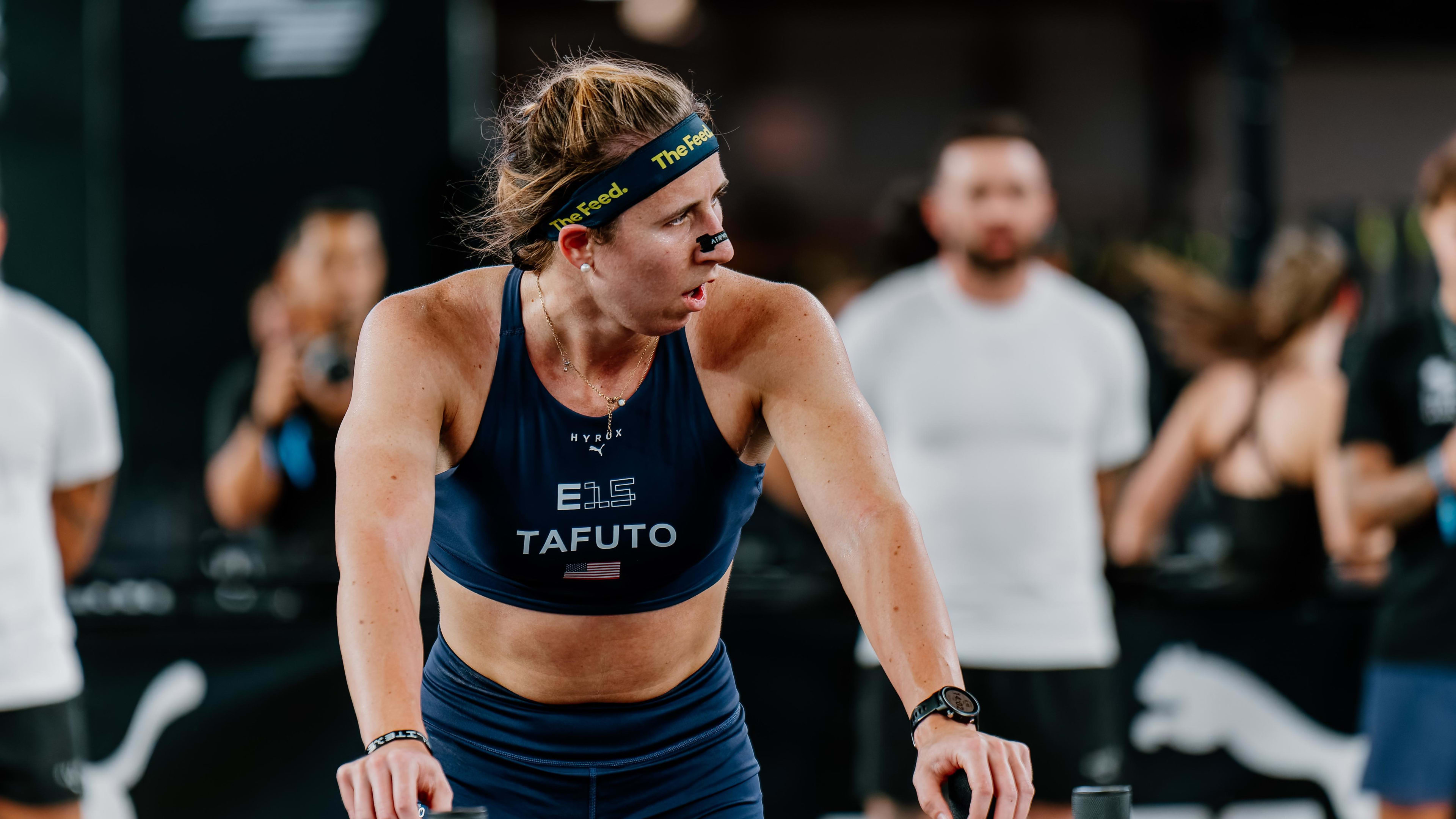
You have trained, prepared, and practiced — now it's time for your HYROX event. HPT Athlete Vivian Tafuto put together a guide to help you come to the line confident and ready to crush.
Like many of you, I would consider myself an extremely food-motivated person. I grew up as a swimmer, and the first time I crossed the full pool length without breathing, my motivation was one thing: the candy prize that awaited me.
Along with my passion for food, my other passion is fitness—more specifically, Hyrox.
I’ve been in the Hyrox space for six whole years now (yes, it has been around that long), and I’ve traveled and raced several times internationally over the last few years. During this time, I’ve learned a few tips and tricks for fueling your Hyrox race in the hours and days leading up to it. Below are some of the things that have worked for me:
Choosing Hyrox Fuel:
Electrolytes are your friend! Once you cramp on the lunges, you never forget it. Travel, warm-ups, and shakeout runs still require electrolytes and fuel (carb loading is good!), so continue to be cognizant of using electrolytes in the lead-up to a race. Experiment with different types as well. I like The Feed’s Watermelon electrolytes if I want something with a bit of extra sugar, LMNT if I want lower sugar and lots of salt, and Mortal Hydration for something in the middle.
Find a gel you like for during the race! The duration of a Hyrox race varies a lot from person to person, and your gel intake could look like anything from zero (not 100% recommended, but sometimes necessary if your stomach is touchy) to 3–4, depending on your duration, fueling habits, and body’s demands. My three criteria for a good Hyrox gel are: 1) easy to open, 2) water-based (nothing super thick), and 3) tastes good. My personal favorites are the Amacx Strawberry and Raspberry and BPN Go Gels. Try fueling during your harder workouts to see if these work for you, and experiment with taking them before and during the race. I’ve had the most success taking one directly after the sled pull.
I personally eat pretty normally leading up to a race (I try not to drop calories much, even though I’m tapering—I love a good carb load), but the day of, I try to limit fiber and go more carb-heavy than normal. I like my last “normal” meal about 4–5 hours out, a mini meal 2–3 hours out, and from there, I continue fueling with easy-to-digest carbs all the way to the start line.
Experiment with things like beet shots, bicarb (I’ve used the Maurten system), and Nomio for racing. Try them in targeted workouts to make sure they work for you and your stomach—there’s a lot of research behind these.
I am also a huge fan of Cheribundi in the days leading up to a race. I take it at night to reduce inflammation and help me sleep.
Speaking of sleep, if you are consistently taking magnesium before bed, continue to do so during taper. Keeping up with routines can help when sleep is a little more disrupted from travel, taper, and excitement.
If you are doubling up on races (praying for you) or just looking to limit soreness and recovery time, one of the biggest factors I’ve noticed that contributes to how quickly I recover is how much I’m able to eat afterward. I know full meals can sometimes be difficult to stomach (I still recommend eating a big one if you can—you just finished a Hyrox—get yourself a burger, you savage), but if you have the ability and foresight, a recovery shake (I like Strawberries and Cream from Scratch) can help kickstart the recovery process.
International Travel:
To save a bit of time and money, I try to book a place with a kitchenette if I can. Sometimes I use it more than others (see below), but this way I always have the option.
This is a trick I got from Lauren Weeks (when the GOAT speaks, you listen!): I pack microwave rice and packaged chicken or tuna in my checked bag for simple foods I know I can eat if I’m having difficulty finding exactly what I want for pre-race meals. These are safe, neutral options in a pinch, and if travel goes sideways and you arrive at an odd time, they come in super handy.
I’m not a huge Uber Eats person typically, but having it available for international travel can be really helpful if you don’t know the area well or are prone to getting lost (I once spent 45 minutes trying to find a restaurant and ended up ordering Uber Eats anyway). This works for meals or grocery shopping (I’ve also had a card decline internationally at a grocery store, so it helps from that angle, too).
Even if you get a kitchenette, don’t feel locked into eating every meal in your hotel. You can enjoy your stay and the local food while still tightening things up in the 24–48 hours before race day.
With all of these tips, I still want you to remember that nothing has to be perfect, and sweating the small things is almost always worse than the small things themselves. There is a fine line between optimization and neuroticism, and it’s important that you enjoy both the race and the time surrounding it. You’ve worked hard for this, and if you’re here for a good time, you’ll be here for a long time.
We are all continually learning and improving, and you won’t always get it right. It’s just another variable you can adjust and refine on your way to a personal best.
Best of luck out there—I believe in you!