HYROX is having a moment right now — from your local gym to the world stage. But knowing you want to do one, and knowing how to train for it, are two very different things. Elite 15 athlete Rich Ryan gives us his breakdown of how to build a program to be race-ready.
If you haven’t heard from a friend or been served by your algorithm, HYROX is hot right now.
Every weekend across the globe, 10s of thousands of athletes are showing up, taking off their shirts, and competing in HYROX together.
The sport has seemed to capture both the casual gym goer and the hyper-competitive triathletes.
The mix of endurance, speed, and strength gives many athletes a chance to try something new that will push them to create real change.
The test is hard, so the feeling of accomplishment is real regardless of your fitness level.
People get hooked on the competitive atmosphere, standardized (ish) courses, and welcoming community.
But HYROX training feels overwhelming. There are nine different skills and a wide range of fitness that should be trained, which can make the training feel daunting and chaotic.
In this article, I am going to explain the foundations of HYROX training so you can be better prepared for your race.
Understand the Demands
There are three main components to consider when preparing for your first HYROX.
Muscular endurance
Aerobic capacity
Anaerobic threshold
Muscular Endurance
Marathoners and triathletes have fantastic muscular endurance. But in a very specialized and fine-tuned way. HYROX will push you into a deeper range of motion at a level of exertion more than any other endurance event. Coming from a track-and-field background, I can tell that the muscular endurance component is HUMBLING.
Training muscular endurance is done the same way as building aerobic endurance. Volume and frequency. Your muscular endurance will be one of the first pieces to decondition. So it also needs to be trained frequently. For that reason, you will be VERY sore in the first few sessions. You might feel so sore that you think you may injure yourself. You won’t, as long as you are paying close attention, learning proper movement mechanics, and slowly adding load. Big jumps in volume or weight with poor mechanics will get you injured. Not the soreness in your muscle belly.
Pro Tip: Start working on your squat mobility early and often. The better you can move into deep knee flexion, the better you will be at HYROX.
Build A Bigger Aerobic Capacity
The high-intensity visuals of the event and the heavy weights might lead people to think that they need to go hard and heavy in training right away. But it doesn’t matter how strong or fast you are if you can’t deliver oxygen to your muscles. Without an engine, the biggest truck will lose to the Prius.
To build your human engine, use volume. Keep your heart rate in zone 2. Start at a slow pace that lets you talk easily or breathe from your nose. You can build your aerobic capacity in MANY ways, including running, cycling, rowing, skiing, and swimming, to name a few. Do this 3-5 x per week.
Avoid the Endurance Athlete Fallacy: The incoming endurance athletes may go way too intense, way too often, because they feel like they have an aerobic advantage. They are correct, but you will eventually condition your aerobic system if you push too hard too often. There should be a trade-off, but make sure to consistently work on building or maintaining aerobic volume.
Anaerobic Threshold
The above will help you complete the event. Anaerobic Threshold training will help you complete the event faster.
Once you are properly conditioned, you will be able to push the intensity so that you can sit just below your red line. Do so in training, and you will run well and complete the stations quickly. If the runs or stations take you beyond what is recoverable, then the other aspect will suffer.
Doing 1-2 days of threshold training per week is a sweet spot. 20-60 mins of accumulated time in Z4 is enough.
Learn from a New Discipline
You need to fuel like both a strength athlete and an endurance athlete.
Supplement For Strength
The strength athlete has historically been obsessed with sports nutrition and supplements. The simple reason is that proper fueling and supplements can get you jacked.
Science agrees.
Creatine is one of the most researched and evidence-supported sports supplements. It increases muscle phosphocreatine stores, which can improve ATP regeneration during short, intense efforts. This often enhances strength, power, repeated-sprint, and explosive performance, as well as training volume over time.
Because creatine is stored in your body, you need to take 5-10 grams daily.
Eat to Recover
Fueling with protein AND carbs is where the worlds collide in what is typically a decision post-training shake. As an endurance athlete, you will burn a lot of carbs during training.
As an endurance athlete who also does strength movements, you will create a lot of muscle damage that you need to recover from.
So take carbs to refuel and protein to restore. SiS Rego is my favorite post-workout shake.
Protein Rule of Thumb: Around 1 gram of protein per lb of body weight will help you preserve and build muscles. I supplement my protein intake with Whey or a Whey Casein Blend 1-2x per day.
Eat For Endurance
Endurance athletes have put a major emphasis on eating while training. And so should a HYROX athlete
We are increasingly understanding the benefits of high-carb training and its effect on performance. The running and triathlon worlds have fully adopted the concept, and I believe it applies directly to HYROX.
Because high-intensity mixed-modality racing relies heavily on glycogen, I assume that HYROX requires more carbohydrate-focused nutrition than a 60-minute running race.
Training high carb for HYROX has helped my training performance and recovery. I highly recommend it.
I suggest you aim for 20-40 grams of carbs per hour.
Pro Tip: Make it simple to get the carbs.
The intensity of HYROX is a rocket blast from the 4th minute onward. The act of eating can seem like a major challenge. Your respiration rate will be sky-high, and the fatigue can be overwhelming.
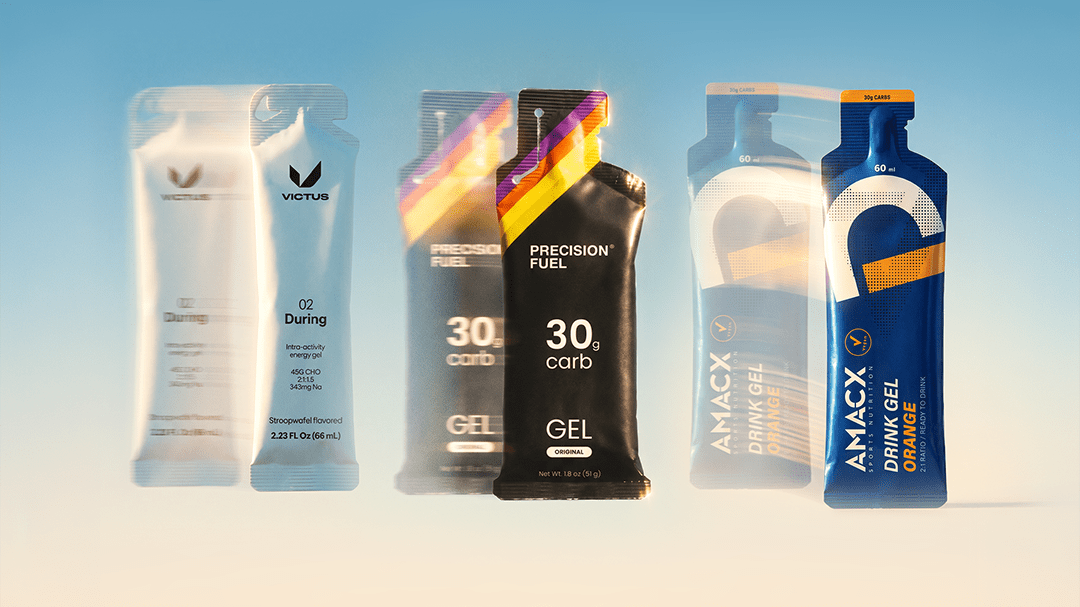
This is where I’ve found the product makes a big difference. For me, the packaging needs to glide open, and the gel needs to slide down smoothly.
Here is what I have found works best:
40 grams
Best: SiS Beta Fuel
Next Best: Enervit
30 Grams
Best: Enervit Liquid Gel
Next Best: Amacx Drink Gel
Learn more from David Roche’s great article about High Carb Training from The Feed here.
Progress and Polarize Your Training
HYROX training works best when it is polarized.
HYROX training can feel like spinning plates. You might want to get better at rowing and burpees, but really, running needs to be the emphasis. So the solution seems to be to do them all.
But then, after several weeks, you don’t really get much better at anything. HYROX training works best when it is polarized. Meaning take your hard days HARD and your easy days easy.
The goal should be no more than 3 hard sessions per week (I suggest starting with 1 or 2).
Strength sessions should be zone two or low-heart-rate work with sets, reps, and rest. Do not use CrossFit strength sessions for this.
A slow straight line will get you there faster than fast zig zags.
Start training at a level that fits you. Slowly build up each week by adding 3-8 minutes to your sessions. This increase may seem small, but consistent progress will help you last longer. Eventually, you will take on so much work that you can do double or triple what you did when you started, at the same pace.
Make training as simple as possible.
There will be, and should be, a learning curve, so sometimes the planning can be a barrier when switching to a new sport. But making a loose schedule is very important so that you can stay the course.
Here is what I l ike a week to look like.
M: Strength / Aerobic (low heart rate effort)
T: HYROX Threshold - 20-60 min at Z4
W: Easy Aerobic
T: Strength / Aerobic (low heart rate effort)
F: Race Specific Threshold
S: Easy
S: Long run / Long Z3
From here, add the progressions until about 3 weeks out from an event. Then reduce total volume to taper yourself into race day.
Good alternatives to programming yourself are finding a HYROX Affiliate near you or joining a program.
There are a lot of options available - but here is a 7-day trial to give you a little whiff of what effective HYROX training can look like from my perspective.
Rich Ryan is a 4x HYROX Elite 15 Athlete Solo qualifier and 2x HYROX Doubles Qualifier with prs of 53:57 Solo and 48:28 Doubles. He lives and trains in Arvada, CO, where he records podcasts, YouTube, and training programs for HYROX athletes. When not training, he hangs with his family and dachshund, Carl.