The workout gets the credit. But what you do in the 30 minutes after it determines whether that work actually sticks. Here's how to capitalize on your training.
You just finished a hard ride. Or a brutal long run. Or the bike-run brick that wrecked you.
You're sweaty, depleted, and the only thing you want is a shower and a couch. Maybe you grab a banana. Maybe you forget to eat anything for two hours because work calls and life keeps moving.
The one thing most athletes don't realize is that the gap between finishing a session and getting real fuel back into their bodies is one of the most overlooked levers in all of training. What you do — or don't do — in the 30 to 60 minutes after a hard session has more impact on tomorrow's workout than most of what you did during today's.
This is true whether you're training for your first triathlon or you're a WorldTour pro. The physiology doesn't change.
What's Actually Happening in Your Body Post-Workout
When you finish a hard session, two things are true at the same time:
Your glycogen stores, the carbohydrate fuel tank stored in your muscles and liver, are significantly depleted. The harder and longer the session, the deeper the deficit. A 90-minute interval ride or a 2-hour long run can empty your tank by 50% or more.
Your muscle tissue is also damaged. Not in a bad way — this is the breakdown that, when paired with proper recovery, leads to adaptation and getting stronger. But until that damage is repaired, you're carrying residual fatigue into your next session.
Your body is as ready to absorb and use fuel as it will ever be in that first 30 to 60 minutes after exercise. Blood flow to your muscles is elevated. Insulin sensitivity is heightened. Miss this window, or under-fuel it, and you're not just feeling tired tomorrow — you're literally starting the next session with less glycogen and more residual muscle damage than you needed to.
The Two Things You Need (And Why Most Athletes Only Get One)
Recovery comes down to two nutrients: carbohydrates and protein.
Most athletes know they need protein. The protein shake is practically a reflex — you finish your workout, you grab one, you feel like you've checked the box.
Here's the problem: protein alone doesn't refill your glycogen stores. And glycogen depletion is what makes tomorrow's session feel like you're running through wet cement.
The other camp goes the opposite direction — they grab whatever's easy, usually carbs (a bagel, a Coke, a banana), and skip the protein. That refills the fuel tank but leaves the muscle repair work undone.
You need both — and research shows they work better together than either does alone. Combining carbohydrates with protein boosts glycogen resynthesis more effectively than carbohydrates alone. The protein helps your body shuttle carbohydrates into muscle storage faster. The carbohydrates trigger an insulin response that drives amino acids into damaged muscle tissue for repair.
The ratio matters too.
Why the 2:1 Ratio Matters
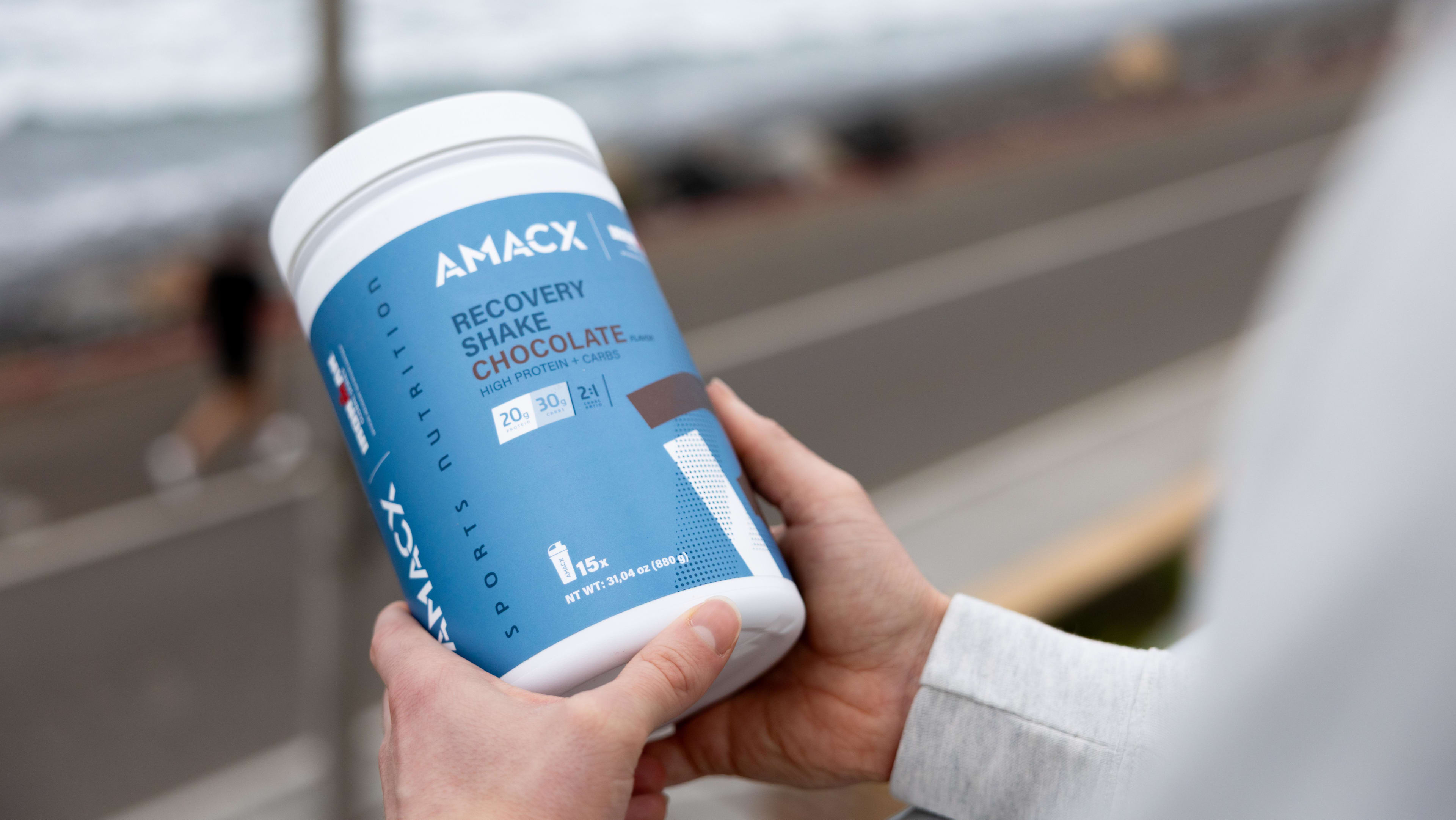
The Amacx Recovery Shake is built around a 30g carbohydrate, 20g protein formula — roughly a 2:1 ratio of carbs to protein.
This isn't a guess. It's the ratio that sports nutrition research has converged on for optimal post-exercise glycogen resynthesis. Enough carbohydrate to meaningfully refill the tank. Enough protein to drive muscle repair. Neither nutrient shortchanged.
The carbohydrate side uses a blend of maltodextrin and fructose. Your gut absorbs these two sugars through completely separate transport pathways — maltodextrin uses one channel, fructose uses another. When you take them together, both channels run simultaneously, which means you're absorbing carbohydrates roughly twice as fast as you would with a single-source formula. The same dual-pathway principle that makes high-carb fueling drinks like Maurten so effective during a workout is what makes the Recovery Shake so effective after.
The protein side is whey concentrate, delivering a complete amino acid profile — including the branched-chain amino acids that are the primary triggers for muscle protein synthesis. Each serving has nearly 7g of leucine, the specific amino acid most directly responsible for activating the muscle repair process.
The Practical Protocol
Within 30 minutes of finishing: mix 2 scoops (58g) with 300–500ml of cold water and drink it. The simplicity is the point — the harder you make recovery, the less you do it.
A few practical notes:
Hot day or particularly hard session? Mix with closer to 500ml. You're rehydrating at the same time.
Want extra calories or training really long? Mix with milk instead of water. You'll add another 8g of protein and some additional carbs — ideal after a 4-hour ride or a marathon-distance run.
Session under 60 minutes at moderate intensity? Skip it. Your next meal will handle it. Save the recovery shake for sessions where you've actually depleted yourself — hard intervals, long endurance days, races.
Every batch is Informed Sport Certified, so if you're competing at a level where that matters, you're covered.
What "Doing Recovery Right" Actually Feels Like
When you start nailing the post-workout recovery window consistently, tomorrow's session feels different. Less heavy in the legs. Less of that low-grade fatigue that hangs around. Your muscles feel loaded rather than depleted. The first 20 minutes don't feel like you're digging out of a hole.
Over weeks and months, this compounds. You absorb more training. You hit your intervals more consistently. You're not constantly fighting accumulated fatigue.
It's why teams like EF Pro Cycling and Visma | Lease a Bike make it a post-ride staple. Racing 200 days a year, the margin between fast recovery and slow recovery is the margin between performing on day three and just surviving it.
You don't need to be racing the Tour to benefit from the same principle. Whether you've got a Saturday long ride followed by a Sunday brick, or a hard interval session on Tuesday with a tempo run on Wednesday, the back-to-back is where recovery shows up.
The Bottom Line
The 30-minute window after a hard session isn't a marketing concept. It's a real physiological state where your body is uniquely ready to absorb fuel and start rebuilding. Skip it, half-ass it, or get the ratio wrong, and you're leaving training adaptation on the table.
The fix is simple: 30g of carbohydrate, 20g of protein, within 30 minutes of finishing. Two scoops, water, shake, drink.
Stack the right habits and recovery stops being the limiter. It becomes the thing that lets you train harder and more consistently — which, over time, is the only thing that actually makes you faster.