The biggest marathon fueling mistakes first-timers make are starting gels too late, taking too few carbs per hour, trying new products on race day, and not sticking to a plan. We'll break these mistakes down and provide solutions so that your first marathon is a success.
Key takeaways
Baseline target: 60g of carbohydrate per hour suits most first-time marathoners. 90g per hour is realistic only with glucose and fructose gels and plenty of gut training.
Gel count rule: gels needed = (finish time in hours) x hourly carb target, divided by grams per gel.
Carb-loading: it's not the big "pasta party" the night before; it's an intentional carbohydrate goal over 36-48hrs.
Spacing rule: at 60g per hour, the minutes between gels roughly equal the grams in each gel, so a 25g gel goes in every 25 minutes and a 40g gel every 40 minutes.
Caffeine rule: one to three caffeinated gels, taken from halfway onward, with the full day kept under the 400mg ceiling for healthy adults.
Why do first-timers underfuel?
First-timers underfuel because a gel seems unnecessary while the legs are still fresh. By the time hunger or brain fog shows up, glycogen is already low and catching up is not an option. The muscles and liver hold a limited amount of it, and at marathon effort you burn it faster than any gel can refill it, so early fueling slows the drain before it starts to cost you pace. A gel also needs time to digest and absorb, which means the one you take at minute 25 is still working for you well into the first hour. Take the first gel 20 to 30 minutes in, then take every gel after it on a fixed clock regardless of your hunger.
Nerves and adrenaline can blunt appetite in the early miles, and your gut can only absorb so much carbohydrate per hour, so a gel you skip at mile 10 cannot be made up for with a double dose at mile 14. A watch alarm set to repeat every 20 minutes takes the work out of it and keeps your plan running when your head is busy with pace and crowds.
Why “nothing new” on race day?
You train your gut the same way you train your legs, with progressive, repeated exposure. Every gel, drink, breakfast, and caffeine dose on marathon morning should already have gone through a few trial runs (literally). First-timers break this rule quite often, by taking free gels at the expo and grabbing an unfamiliar brand at aid stations. Settle on your fuel plan weeks in advance and rehearse it on multiple long runs.
Check the race website for the on-course gel and sports drink brand. If you can buy that exact product and train with it, you can carry fewer gels. If you cannot, carry everything yourself and treat aid stations as water or hydration stops only.
Repeated carbohydrate intake during training lets athletes tolerate more carbohydrate during exercise. The adaptation is specific to the work you do, so gels taken on an easy 10K teach you little about gels taken at marathon pace in hour three.
Is carb loading just a big pasta dinner the night before?
No. The old-school method of "carb loading" was not ideal for preparing for a big event. Proper carb loading is intentionally eating more carbohydrates at every meal for 36 to 48 hours before the race, which adds up to far more than one big dinner. First-timers get it wrong in three ways, which are: loading too little, loading only the night before, and not reducing high-fiber or high-fat foods. Aim for bigger portions of rice, bread, and potatoes and smaller salads, veggies, and fatty foods. Why? These things take up space in the gut and require more digestion.
The target is ~10 g of carbohydrate per kilogram of body weight per day for the 36 to 48 hours before an event over 90 minutes. For a 70kg runner, that comes to 700 to 840g per day, far more than one pasta bowl. Spread it across meals and snacks, and expect to gain a tiny bit of water weight, but that is glycogen storing properly. Again, something that requires some practice.
The night-before meal should be familiar, low in fiber and fat, and finished at least three hours before bed. Skip the new restaurant, since an untested dinner breaks the same rule as an untested gel.
What should breakfast on marathon morning look like?
Breakfast should be familiar, low-fiber, low-fat carbohydrate eaten two to three hours before the gun, which is earlier than most first-timers plan for. White toast with jam, a bagel, or a banana with a small coffee (if coffee is your normal routine) all fit. Skip anything you have not eaten before a long run.
The recommended range is 1 to 4g of carbohydrate per kilogram in the one to four hours before exercise. A 70kg runner eating three hours out might aim for 100 to 150g, which is two bagels with jam and a banana. Granola with yogurt and berries is a poorer fit because of the fiber and dairy.
On marathon morning, avoid high-fiber cereals, large servings of dairy, fried food, spicy food, and a bigger coffee than usual. Each of these either digests slowly or sends you to the port-a-potty.
It's Race Day: How to plan your marathon fueling
A marathon fueling plan takes three inputs, which are your finish time, your gel size/carb amount, and an hourly carbohydrate target. For a first marathon, set the target at 60g per hour and divide it by the grams in your gel to see how many gels you need each hour. Then multiply by your finish time to get your total for race day. Our marathon fueling plan with gels includes a table covering finish times from 3:00 to 5:30 and gel sizes from 20g to 40g, so you can read your count directly from it.
Once you have the count, space the gels evenly and match the minutes between them to the grams in each one. That means a 25g gel every 25 minutes and a 40g gel every 40 minutes. Set a watch alarm on that interval, take plenty of water with each gel, or write the schedule down somewhere.
If you plan on leveraging some of the aid stations, like taking Gatorade or sports mix, just be aware of how it fits into your plan. In small amounts, it shouldn't really affect your overall fueling plan.
What are the most popular gels and gear for marathoners?
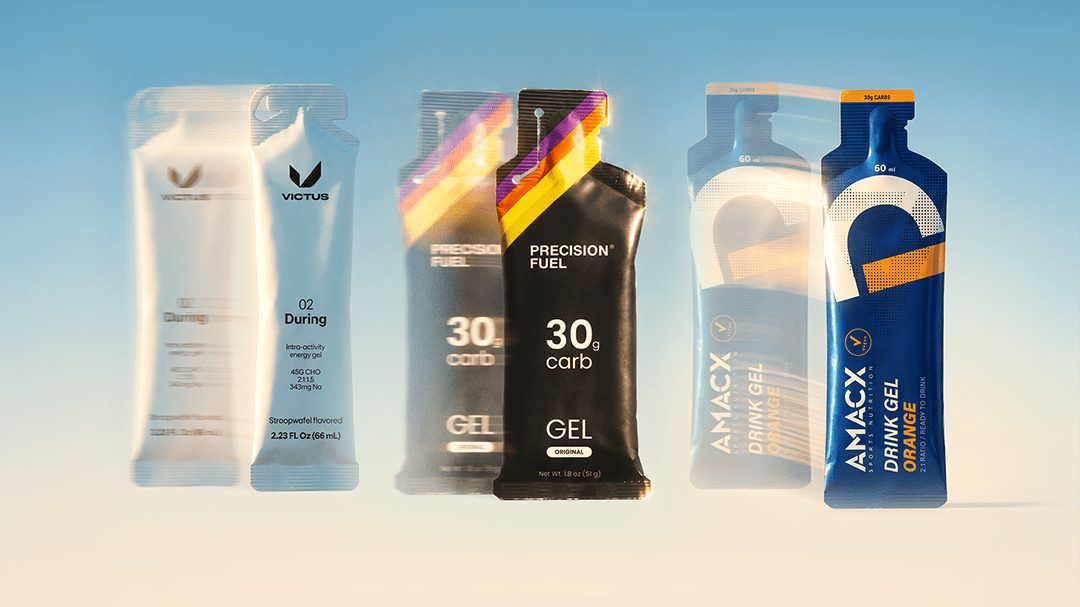
Most marathoners carry their own gels and use the course for water, so the gel you pick sets your count and your spacing. The grams per packet below come from the product pages, and they decide how often you take one on a 60g per hour plan.
GU Energy Gel has about 22g of carbohydrate per packet.
Best for: runners who want smaller servings and a range of flavors.
SiS GO Isotonic has about 22g per packet.
Best for: runners who want a gel that goes down easy, without needing to chase with water.
Maurten Gel 100 has 25g per packet.
Best for: those wanting the most gut-security and willing to pay a bit more.
Precision Fuel and Hydration PF 30 Gel has 30g per packet.
Best for: a sweet spot gel that is small but carries plenty of carbs
Maurten Gel 160 and SiS Beta Fuel Gel each have 40g per packet.
Best for: athletes with gut training reaching higher carbs/hr or anyone who wants fewer gels to deal with.
Aid stations at most marathons hand out water and a sports drink of some kind. A standard 120 to 180ml cup has 7 to 11g of carbohydrate, which is under half of a 25g gel, so the drink works as a top-up between gels. Check the race website for the on-course brand and train with it if you plan to use it.
For carrying and pacing, a running belt holds the gels you need, and something like the Polar H10 heart rate sensor or COROS heart rate monitor gives you on-demand pacing checks along the way.
FAQ: Which first-marathon fueling questions come up most?
What is the 80% rule in running?
The 80% rule, often called 80/20 training, means running about 80% of your weekly mileage at an easy, conversational effort and only 20% at harder intensities. Some runners also apply it to race day, holding back for the first 80% of the marathon and only pushing in the final 20%, which protects glycogen and keeps the gut working.
What foods should I avoid before a marathon?
In the 24 to 48 hours before, avoid high-fiber foods such as large salads, beans, and bran cereals, plus fried or high-fat meals and anything unfamiliar. On race morning, also skip large dairy servings, spicy food, and more coffee than usual. Stick to low-fiber carbohydrate you have eaten before long runs.
How do I run a marathon as a first-timer?
Build weekly mileage gradually over 16 to 20 weeks with one long run per week, practice your race-day fuel on those long runs, carb load for 36 to 48 hours before, start the race slower than feels natural, take 60g of carbohydrate per hour on a fixed clock with water, and refuel with carbs and protein within an hour of finishing.
What does hitting the wall feel like and how does fueling prevent it?
Hitting the wall feels like a sudden loss of power, heavy legs, foggy thinking, and sometimes shakiness, usually between miles 18 and 22. It happens when muscle and liver glycogen run low. Carb loading before the race raises glycogen stores, and taking around 60g of carbohydrate per hour from early in the race slows how fast they drop.