A good marathon fueling plan built around gels comes from three inputs: your finish time, your gel size, and an hourly carbohydrate target. In this article, we'll show you how to plan for your next marathon.
If you're lining up for a marathon soon, the training is only part of the equation. Your fueling is the make-or-break of a PR or an "I may not make it" day.
The short of it is: choose an hourly carbohydrate target, divide it by the carbohydrate amount on your gels, space the gels evenly starting ~30 minutes into the race, take water/hydration with each one, and rehearse the full schedule on your long runs.
Let's dive in.
What hourly carb target should a marathoner build the plan around?
The old 60g standard still fits if you are completely new to fueling. In reality, the 90g is the new baseline for athletes training their guts.
Target 60g of carbohydrate per hour as a baseline and 90g per hour if you have trained your gut with glucose and fructose blends. Divide that hourly target by the grams in your gel. At 60g per hour, a 25g gel means roughly 2.5 gels per hour, while a 40g gel means 1.5 per hour.
The gut absorbs single-source glucose at a maximum of about 60g per hour, and adding fructose through a second transporter raises the ceiling to around 90g per hour. Elite marathoners and well-trained amateurs push past 100g per hour, but only after a lot of practice.
What does the gel count look like for a 3:00, 4:00, or 5:00 runner?
A 3:00 marathoner needs about 4 to 8 gels, a 4:00 runner 6 to 11, and a 5:00 runner 7 to 14, depending on gel size, at a 60g per hour target. The table below will help you explore the count for 20g, 25g, 30g and 40g gels.
Find your finish time in the left column and your gel size across the top. The table assumes gels only, with no sports drink, and starts fueling at the 30 minute mark because breakfast covers the opening miles.
| Finish time | 20g gels | 25g gels | 30g gels | 40g gels |
|---|---|---|---|---|
| 3:00 | 8 | 6 | 5 | 4 |
| 3:30 | 9 | 8 | 6 | 5 |
| 4:00 | 11 | 9 | 7 | 6 |
| 4:30 | 12 | 10 | 8 | 6 |
| 5:00 | 14 | 11 | 9 | 7 |
| 5:30 | 15 | 12 | 10 | 8 |
For a 90g per hour plan, multiply the number in your cell by 1.5 and round up, so a 4:00 runner on 40g gels moves from 6 gels to 9. If you plan to drink sports drink on course, subtract one gel for every 25 to 30g of carbohydrate you expect to take in.
Why do two runners at the same pace end up with different gel totals?
Gels range from about 20g of carbohydrate per packet to 40g or more, so two runners with identical finish times can need packet counts that differ by a significant amount.
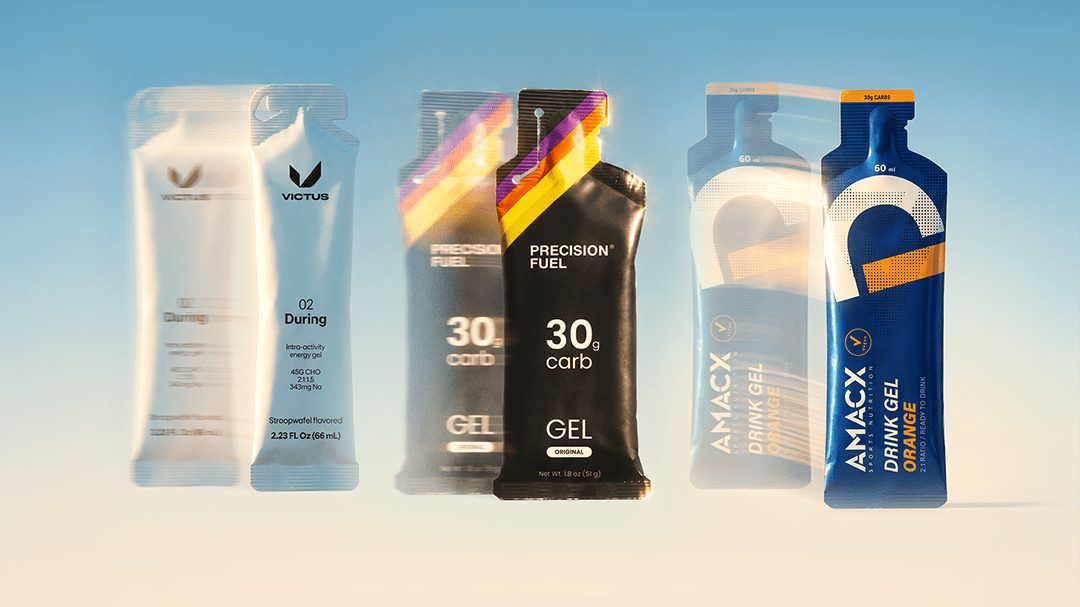
For reference, GU Energy Gel and SiS GO Isotonic each sit lower around 22g of carbohydrate per packet, Maurten Gel 100 lists 25g, Precision Fuel and Hydration PF 30 Gel lists 30g, and Maurten Gel 160 and SiS Beta Fuel Gel each sit at 40g.
So, know before you go.
What gel interval keeps fuel coming in even from the first mile to the last?
Take your first gel around 30 minutes in, then space the rest by gel size, which, at 60g per hour, means the minutes essentially match the g/carbs, so a 25g gel every 25 minutes and a 40g gel every 40 minutes.
One pro tip is to set your watch to buzz on the interval instead of relying on mile markers, since your pace will drift in the final 10k and the clock will not.
Keep them coming in "early and often".
Is a gel on the start line necessary?
A gel in the final 10 to 15 minutes before the gun is a proven way to top-up before the initial kick. Even after a breakfast eaten two to three hours earlier. Avoid taking it 30 to 60 minutes before the start, when some runners get an energy dip, as this can cause a rebound hypoglycemic effect.
What do aid stations contribute?
You still need gels, but fewer of them. A standard aid station cup of Gatorade or sports mix has only a fraction of a gel’s carbohydrate, so on-course drink is best treated as a top-up between gels.
If you want sports drink to supply more of your carbohydrate, bring your own bottle at a known concentration, which suits a vest better than a road marathon belt. For most runners, the plan is gels for carbohydrate and aid station water for fluid or hydration needs, with on-course drink as a small bonus.
Where do caffeinated gels fit?
Include one to three caffeinated gels at specific times, and only if you have practiced them in training. Take the first at or after halfway and the last 30 to 40 minutes before you expect to finish, so the caffeine peaks during the hardest miles, keeping your full-day total under the 400mg ceiling for healthy adults.
Caffeinated gels typically contain 25 to 100mg each, so three 100mg gels plus a pre-race coffee can approach the 400mg daily limit for healthy adults. Caffeine takes roughly 30 minutes to peak, which is why a gel at mile 20 helps you through mile 23, and a gel at mile 25 has no time to act.
What does the plan look like written out mile by mile?
A 3:30 plan assumes 8:00 per mile, one 25g gel every 25 minutes and a 60g per hour target.
Gel 1 at the start line
Gel 2 at 0:30 (mile 3.75)
Gel 3 at 0:55 (mile 7)
Gel 4 at 1:20 (mile 10)
Gel 5 at 1:45 (mile 13)
Gel 6 at 2:10 (mile 16)
Gel 7 at 2:35 (mile 19.5)
Gel 8 at 3:00 (mile 22.5)
The 4:30 plan assumes about 10:18 per mile and one 40g gel every 40 minutes.
Gel 1 at the start line
Gel 2 at 0:30 (mile 3)
Gel 3 at 1:10 (mile 7)
Gel 4 at 1:50 (mile 11)
Gel 5 at 2:30 (mile 14.5)
Gel 6 at 3:10 (mile 18.5)
Gel 7 at 3:50 (mile 22)
How do you train your gut?
Taking more carbohydrate than your gut has been trained to absorb leaves sugar in the intestine, which pulls in water and causes bloating, sloshing, nausea or an urgent bathroom stop. Most problems start above 60g per hour in untrained runners, which is why you rehearse your race dose on at least four long runs.
Use your race gel at your race count and interval on every long run of 90 minutes or more during the final six to eight weeks, and take them at race pace rather than during walk breaks. Runners who struggle with the texture of a large packet can split the dose, for example using Gel 100 at closer intervals rather than Gel 160 less often, so each serving is smaller and easier to get down over a few minutes.
If your stomach is sensitive, start gut training earlier at a lower hourly target, raise it by about 10g per hour every couple of weeks, and stay at the current level until it causes no trouble.
FAQs
How often should I take a gel during a marathon?
Start 30 to 45 minutes in, then take a 25g gel every 25 minutes or a 40g gel every 40 minutes at 60g per hour. A 90g per hour target shortens those gaps by about a third.
Should I take a gel before a marathon starts?
Yes, one gel 10 to 15 minutes before the gun adds to a breakfast eaten two to three hours earlier. Skip the 30 to 60 minute window before the start and count the pre-race gel as a bonus outside your hourly total.
Do I still need gels if I drink Gatorade at aid stations?
Yes. A 120 to 180ml cup of Gatorade Thirst Quencher, a solution of about 6 percent carbohydrate, has 7 to 11g, which is under half the carbohydrate in a 25g gel. Subtract one gel for every 25 to 30g you swallow.
Can you take too many gels in a marathon?
Yes. Going beyond the carbohydrate your gut has practiced absorbing, which is usually above 60g per hour for untrained runners, leaves sugar in the intestine and brings on bloating, sloshing, nausea or diarrhea. Rehearse your race dose and interval on at least four long runs.