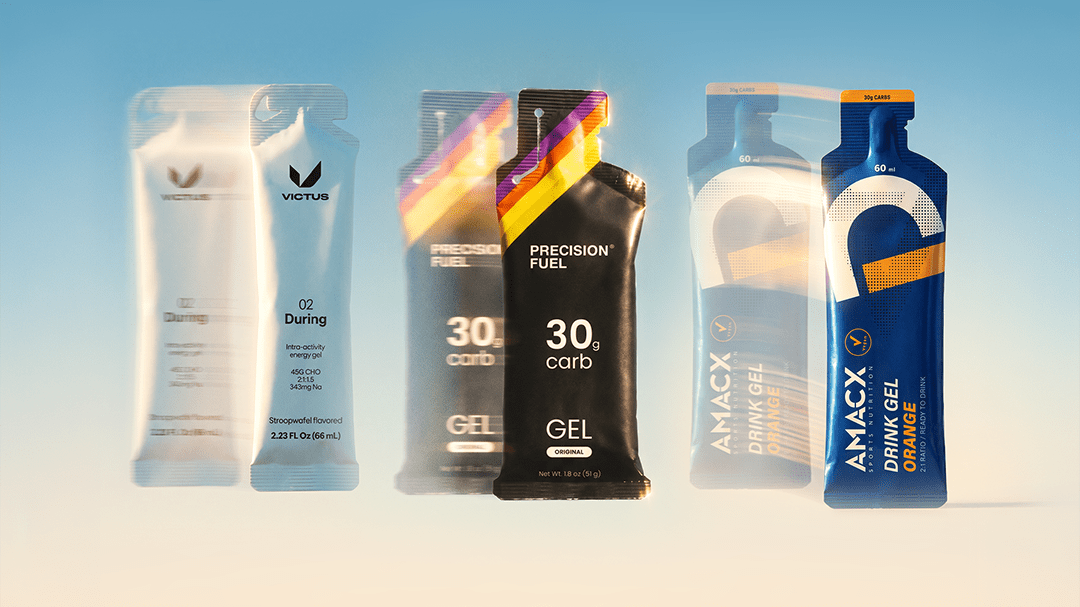
Fueling with gels isn't just for pro athletes. Any runner training for a marathon should use gels as part of their plan. Here are the best energy gels for marathon training and race day, and how to implement them.
Marathon training stacks weekly long runs that stretch past just one or two hours, each one building upon the next as you prep for race day. Under-fueling a single training session may not seem like a big deal, but it severely limits the growth and adaptations that can come from it. Do that often, and you are limiting your progression as a whole.
One of the best ways to fuel your runs is through gels. Not only does running burn through stored carbohydrate, but it does so at a pace that is faster than your gut can digest solid food to replace it. Running at any pace shunts blood away from your stomach and toward your legs, so anything that takes real digestion stalls out exactly when you need the energy most. Gels remove that barrier by delivering fast carbohydrates in a form your body can absorb without shifting much blood to do so, which is why they're part of any training block or long run, not something you save for race day.
Fueling with gels isn't just a pro-athlete habit built for elite marathon times. Any runner building toward a marathon will burn through glycogen stores long before a long run ends, regardless of pace or experience level. Skip the gels during training, and you're not just slower on that Saturday run; you're also never giving your gut the practice it needs to handle fuel on race day.
This guide ranks the best energy gels for marathon training and race day, then shows how to pick by carb dose, preferences, and caffeine. Browse the full gels hub, the gels pack builder, and the Top Gels of 2026 variety pack if you want to test formats before buying a full box.
When should marathon runners start taking gels?
Start taking gels early in a marathon, before you feel the need for it (that's key). Most marathoners take a gel at the start and then their next gel around mile 4 to 6, or 30 to 45 minutes in, then repeat every 20 to 45 minutes depending on gel size and carb target. Always practice the exact product and timing on long training runs. Race morning is for executing a plan you already proved.
How many carbs per hour do marathoners need?
Most marathoners aim for roughly 30 to 60 grams of carbohydrates per hour across the full distance. Athletes targeting a faster finish push toward 60 to 90 grams per hour with dual-source gels (glucose plus fructose) that use separate gut transporters. For elites? They're targeting 90 - 120 g an hour.
Quick math for race day:
| Gel size | Timing example | Approx carbs/hour |
|---|---|---|
| 25 g (Maurten 100) | Every 30 min | ~50 g |
| 30 g (PF30 / Amacx) | Every 30 min | ~60 g |
| 30 g | Every 20 min | ~90 g |
| 40 g (SiS Beta Fuel) | Every 30 min | ~80 g |
| 50 g (Carbs Fuel) | Every 30 to 40 min | ~75 to 100 g |
Higher rates need gut training during your marathon build, ideally starting 6 to 8 weeks out on long runs. Do not jump to 90 g per hour on race day without practice.
What is the best overall energy gel for marathon training?
Maurten Gel 100 is the top pick for most marathoners who want one reliable gel for long runs and race day. Hydrogel technology wraps the carbs, which makes it gentler on the stomach late in a marathon, when GI distress is most likely. About 25 g of carbs per serving, with a clean taste profile that holds up at race pace.
Take with a little water if that is how you trained. For the final push, step up to Maurten Gel 100 CAF 100 (about 25 g carbs plus 100 mg caffeine).
What are the best energy gels for marathon training?
Best overall, one of the favorites of pro runners.
Hydrogel format, about 25 g carbs, built for smooth intake at race pace. Default long-run and marathon pick for many athletes.
Best consistent 30 g gel for structured plans.
30 g carbs in a smooth, neutral pouch that is easy to dose every 20 to 30 minutes. Strong choice when you want simple math toward 60 to 90 g per hour.
Best drinkable gel when you want something that goes down easy.
30 g carbs in a 2:1 glucose-fructose ratio, about 200 mg sodium, thin enough to drink. Ideal for runners who hate thick syrup mid-stride.
Best high-carb gel when you want fewer packets.
About 40 g carbs with a dual-source ratio and real fruit flavors. Useful when carrying capacity is limited and you still need a high hourly carb target.
Best classic flavor-forward gel for many runners.
Roughly 20 to 22 g carbs depending on flavor, wide flavor range, and a texture most road runners already know. Great entry gel and aid-station familiar option.
What should marathoners plan for on race-day logistics?
Course aid stations rarely carry the exact gel you trained with, so carry your own supply in a race vest, gel flask, or belt rather than relying on what's offered on course. Figure your total carb need across the full distance, then pack gels, or a gel flask refilled from gels, that meet it with a buffer for a missed or dropped packet.
Missing a scheduled gel mid-marathon or skipping an aid station risks more than it would on a training run.
How should marathoners choose and stack energy gels?
Pick one primary gel for your marathon build, then add a second format only if it fills a real gap (drinkable texture, higher carbs per packet, or caffeine).
| Goal | Best pick | Notes |
|---|---|---|
| Best overall / hydrogel comfort | Maurten Gel 100 | Default race gel for many runners |
| Simple 30 g dosing | Precision Fuel PF30 | Easy hourly math |
| No-water drinkable texture | Amacx Drink Gel | 30 g carbs + sodium |
| High carbs per packet | SiS Beta Fuel (~40 g) or Carbs Fuel (50 g) | Fewer opens per hour |
| Flavor variety / familiar classic | GU Energy Gel | Wide flavors, ~20 to 22 g |
| Late-race caffeine | Maurten Gel 100 CAF 100 | 100 mg caffeine |
| Test several formats | Top Gels of 2026 | Variety pack before you commit |
Optional isotonic classic: SiS GO Isotonic Energy Gel if you want a no-water-needed traditional SiS gel instead of Beta Fuel's higher carb dose.
Rehearse every gel during your long runs, with the same water bottles, vest pockets, and pace you will use on marathon day.
Hydrogel vs drinkable vs traditional gels for marathon runners
Hydrogel (Maurten): Carbs held in a gel matrix that goes down easier at high intensity. Best when stomach comfort is the limiter.
Drinkable (Amacx): Thin liquid you can sip without a water chase. Best when a thick syrup slows you down.
Traditional / maltodextrin-style (GU, many classics): Familiar texture and flavors. Best when you already tolerate them and want variety.
High-carb dual-source (SiS Beta Fuel, PF30, Carbs Fuel): Built for higher grams per hour with fewer packets. Best after you gut-train the dose.
FAQ
What is the best energy gel for marathon training? Maurten Gel 100 is the best overall pick at The Feed for most marathoners who want hydrogel comfort and a proven race-day gel.
How often should I take a gel during a marathon? Most marathoners take a gel every 5K to 8K, or every 20 to 45 minutes after the first hour, matched to carb target and gel size. Practice the exact timing on long training runs.
Do I need water with every gel? Take Maurten and most traditional gels with water. Amacx Drink Gel and SiS GO Isotonic are built thin enough to need little or none. Follow how you trained.
What if I need more carbs per hour? Move toward 30 to 40 g packets (PF30, Amacx, SiS Beta Fuel) or 50 g Carbs Fuel, and increase intake gradually over weeks.
Should I use caffeine gels? Optional. Maurten Gel 100 CAF 100 adds 100 mg caffeine for the final miles of a marathon. Test it on a hard long run first.
Are these medical products? No. These are sports nutrition fuels for training and racing. See a qualified professional for individualized nutrition advice.