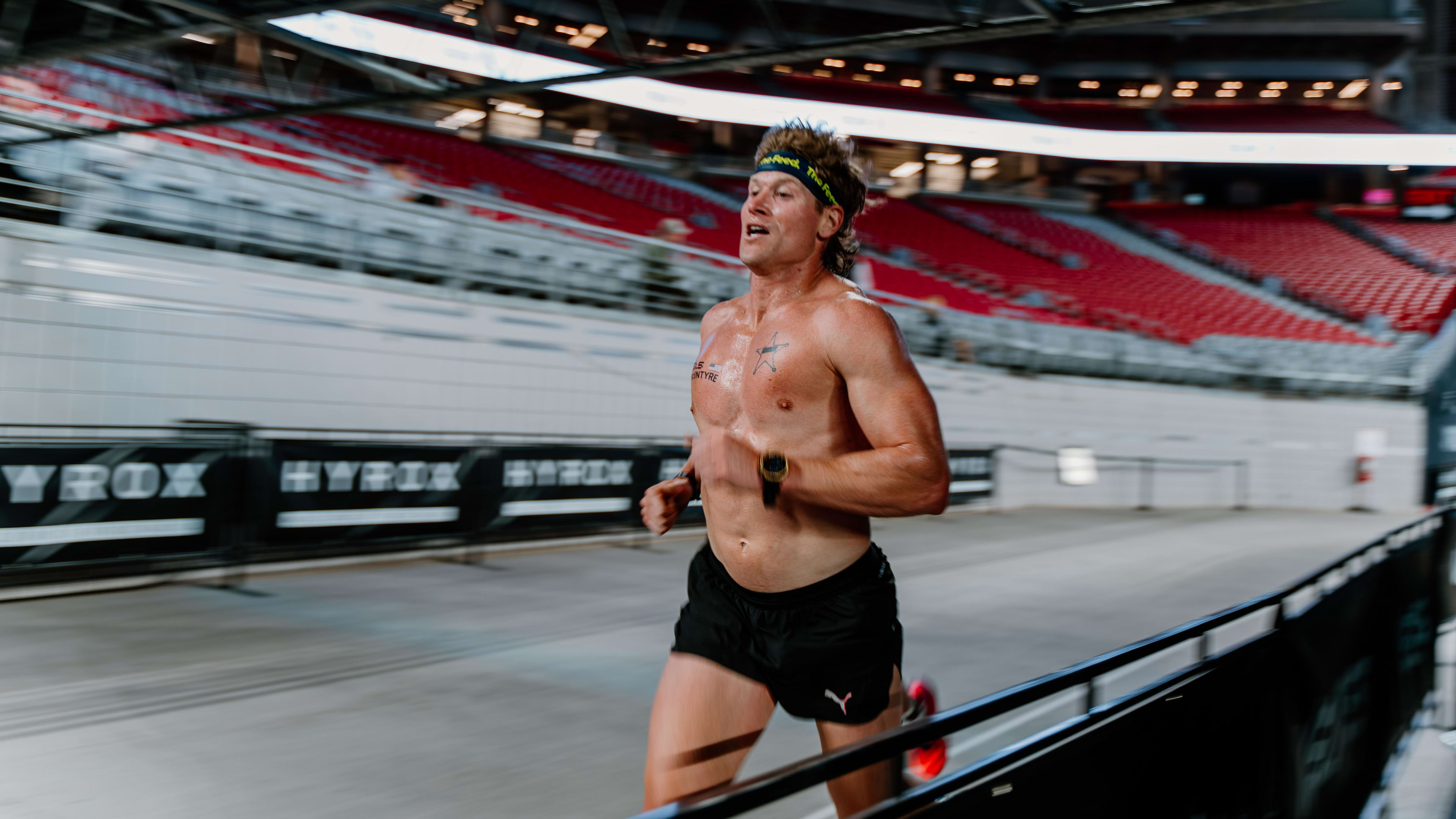
No one has watched HYROX evolve from the inside quite like Hunter McIntyre. He's a five-time world record holder and a big presence throughout the sport's development. Here's what he's learned — about the sport, about performance, and about what actually works.
THE SPORT THEN VS. NOW
When HYROX first got started, nobody wanted to show up. It was basically an empty room — just me and a couple of other people. I spent a lot of time working with the company to do invitationals, media, just my own content, trying to get people to take it seriously. I'm not saying I was laying the bricks on the road, but showing up consistently, competing at a high level, and going into other sports to compete against them — I think that helped. Now it's got its own wings and it's going in its own direction. It's been a wild ride to watch.
ON "WORLD RECORDS"
The sport is changing its rules constantly. They'll say 'this is the format for the rest of the year,' and then you go to a different venue, and it's a completely different course. They release a new kit and suddenly sled times drop 30 to 40% — that's a massive factor. If you want to call something a world record, it needs to be on a verified, standardized course. Think about the Boston Marathon — you can't set a world record there because it's not a verified course. That's what prestigious sports do. HYROX hasn't reached that point yet.
I held the world record for five years, and then, within less than four months in the new setup, over ten people broke it — people I've never even heard of. That tells you something about the standard being applied.
WHY ATHLETES KEEP GETTING FASTER
A few things are converging. First, information. The coaching platforms and nutrition resources out there now are genuinely good. Second, equipment — we used to race in non-carbon-plated shoes. I was in a pair of Brooks. Now everyone's in super shoes. If you look at what super shoes did for the marathon, it's roughly a four-and-a-half-minute difference. That's enormous. And then there's nutrition — understanding not just what to take, but how much, and when. It's the same reason you look at the Tour de France differently now. These guys have liquid carbohydrates, electric-shifting carbon fiber bikes — it's a different era. The sport gets faster because everything around it gets better.
HOW MY OWN NUTRITION HAS EVOLVED
I was pretty dialed even back then — we were using beta-alanine, gels, the basics. But the quality has improved and my understanding of quantity has gotten a lot more precise. One of the bigger shifts was moving from beta-alanine to bicarb. It's an incremental difference, but it's a real one. Overall, though, it's all been improvements. Anyone in the elite 15 has some kind of formulated plan at this point — nobody at that level is just winging it anymore.
THE FIVE PRODUCTS THAT ACTUALLY MOVE THE NEEDLE
In the pre-workout category — and I mean performance-based, not stimulant stuff — bicarb. That's it for things you can actually get your hands on right now. Beyond that: carbohydrates, and honestly, the source matters less than what you'll actually eat and absorb — fructose, glucose, maltodextrin, whatever works for your gut. Creatine, but do it in powder form. By the time creatine gets processed into a gummy and put through heat, the quality degrades badly. Citrulline or other nitric oxide compounds if you're training hard and want to support blood flow. And amino acids — for HYROX athletes specifically, the combination of endurance and strength work makes it really easy to go catabolic over long sessions, and aminos help you hold muscle mass through that.
BICARB OVER BETA-ALANINE
It comes down to the mechanism. Both are buffering agents, but bicarb works systemically, and the effect is more direct for the kind of high-intensity work we're doing in HYROX. Beta-alanine has its place, but when I started looking more closely at the research and working with exercise scientists who are actually pushing the boundaries of what we understand, bicarb became the clear call. The tingling from beta-alanine is also just not something you want to be dealing with mid-race.
WHAT "DIALED IN" ACTUALLY LOOKS LIKE
I weigh my food. I track everything on MyFitnessPal. I walk around with a lunchbox. When I was having breakfast with people this morning, everyone was just grabbing whatever — I was reading the macros on the back of everything before I picked it up. It's not glamorous, but it's the job.
I think about it like this: imagine deciding to drive across the country and flooring the gas pedal the whole way without ever once checking the gas tank. That's how most athletes approach nutrition. They want to go hard, but they never look at what they're actually running on.
FUELING FOR A SPORT THAT'S BOTH
The amino acid piece is a big part of it. You're putting in serious endurance volume and serious strength work, and those two things pull your body in different directions nutritionally. Getting enough protein over those long sessions while also staying fueled for the cardio side is genuinely hard. Aminos help bridge that gap. Beyond that, carbohydrates are still your primary fuel source during the race itself — don't overthink the source, just make sure you're taking in enough and that your gut can handle it on race day.
THE MOST COMMON MISTAKE
Hydration. It's not even close. People come to me saying their energy is low, they're not recovering, they can't figure out what's wrong — and when I ask how much water they're drinking, they have no idea. Some of them are basically running on coffee and Coke Zero. You'd be amazed. It's the most basic thing, and it's the most overlooked. Fix hydration before you start worrying about any of the fancy stuff.
WHERE I GO FOR INFORMATION I ACTUALLY TRUST
A handful of exercise scientists who are genuinely doing the work — not just publishing what's already known, but pushing beyond it. Kristian Blumenfeld's team is a good example of the kind of operation I'm talking about. This year I started working with a scientist who added an SMO2 sensor to my leg during VO2 max testing — measuring blood oxygen saturation in the muscle in real time. That's a whole second layer of information that most people aren't looking at. Beyond that: books, and constantly scanning the internet for new research. And when I find a charlatan, I try to expose them.