Fueling used to be guesswork. Now it's a science. Bobby Julich spent 40 years figuring it out one bonk at a time. Mike Woods is living at the other end of that evolution — from the WorldTour to privateer gravel.
Ask a pro cyclist from the 1980s what their fueling strategy was, and you'd probably get a shrug and a banana. Ask Mike Woods what his fueling strategy was during his 2023 Tour de France stage win, and you'll get something specific: 100–110 grams of carbohydrate per hour, delivered almost entirely through gels, drink mix, and tracked to the gram. Somewhere between those two answers lies 40 years of professional cycling figuring out that fueling isn't just an afterthought; it's the biggest performance lever there is.
Bobby Julich lived through that entire evolution. He started racing at 13, is about to turn 55, and spent his career going from "eat when hungry, drink when thirsty" to working for a continuous glucose monitor company testing every product on the market. Woods, meanwhile, gives us the modern endpoint in real time — what precision fueling actually looks like on a WorldTour team car, and what happens to that precision once you leave the WorldTour behind entirely for gravel.
The Banana Years
Julich remembers the mid-80s clearly: for anything under 90 minutes, you didn't think about food at all. For longer rides, it was a banana in your back pocket, and bonking was just something that happened to you. Something you got better at handling, not something you planned around. His first real exposure to sports nutrition came through his father, who left a job at UPS to sell Power Bars in Colorado. That's where he started "fueling".
"Eating a Power Bar 30 minutes before a race became a habit, almost a superstition, that stuck with me my entire career. I still bonked plenty of times..."
There was no science yet, just superstition. Just eating a Power Bar before a race became a career-long ritual for Julich, not because he could prove it worked, but because it felt like it did.
Learning the Hard Way
Turning pro complicated things rather than simplifying them. Julich bounced between a team culture of eating as much as physically possible and, the very next year, the opposite: the European "regime," where the goal was eating as little as possible to stay skinny. His actual system — drinking more than his teammates, taking a gel immediately post-race to catch the glycogen window, eating boiled potatoes his soigneur made him even while teammates mocked him for it — came from trial and error, not a nutritionist. He didn't have one. Nobody did.
That changed at Team Sky, where Julich met his first team nutritionist — at the time, he says, the least popular person on the roster. Today, most WorldTour teams run five to eight of them.
What Precision Nutrition Looks Like
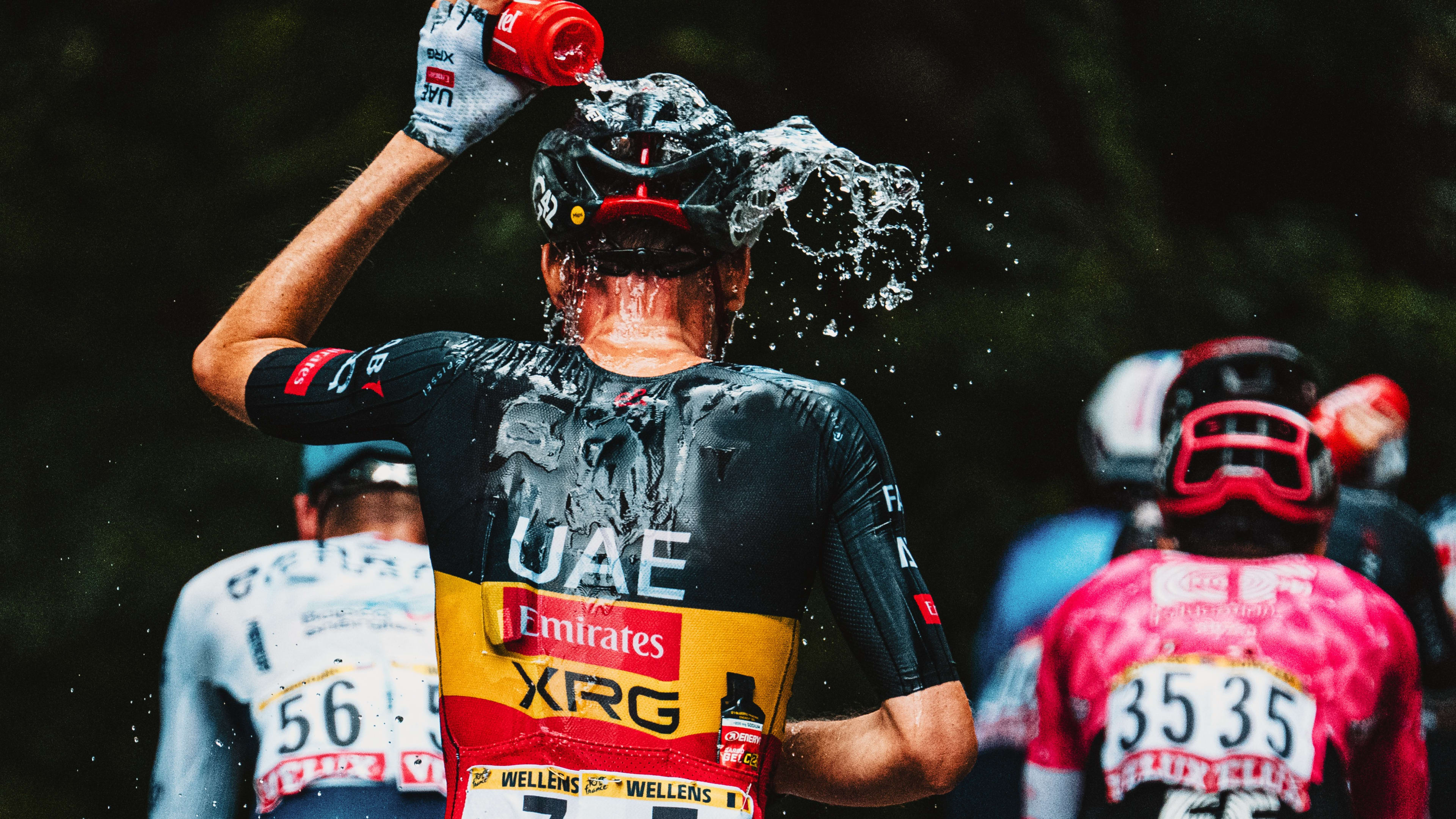
This is where Woods picks up the thread. On the morning of his 2023 Tour de France stage win, breakfast wasn't a guess — it was crepes, rice, eggs, and maple syrup, engineered to hit at least 150 grams of carbohydrate because the team knew the stage would demand it. During the race, at the pace they were riding, solid food wasn't an option. It was a gel day: 100 to 110 grams of carbohydrate per hour, Santa Madre Carbo Fuel in the bottles, 60-gram gels in the pockets, and a team car following close enough to hand off ice water for both drinking and cooling.
That number — 100 to 110 grams an hour — would have sounded like fiction to Julich in his racing days, when 60-90 grams was considered the outer limit. Now it's standard, and Julich says the shift is directly tied to continuous glucose monitoring data revealing just how much the gut can actually be trained to handle.
I tested basically every fueling product on the market for three years. What I learned is that metabolism is like a snowflake — everyone's is different. What used to be the ceiling is now considered a minimum.
Riders today are hitting 120-plus grams an hour, treating the gut like any other trainable system.
The Race After the Race
Recovery is where both riders land in almost the same place, despite racing eras apart. Julich calls it "the race after the race". Gels, sugary drinks, Haribo candy, a protein shake, then a full meal — all timed to the glycogen window he stumbled into decades ago. Woods' version is nearly identical in spirit: cherry juice immediately after the finish, then rice and eggs. The products have modernized. Julich mentions recovery shakes and electrolyte drinks didn't really exist when he raced; Woods leans on cherry juice built specifically for recovery — but the underlying instinct, get carbs and protein in fast, hasn't changed at all.
Life After the WorldTour
Where the two riders' stories diverge is what happened once racing stopped. Julich's path went from the bike to coaching, taking a role with Team Sky and encountering his first-ever team nutritionist along the way — at the time, the least popular person on the roster. From there, he moved further into the science itself, spending three years around 2020 working for Super Sapiens, a continuous glucose monitor company.
Woods' post-Tour path looks nothing like that. He walked away from the WorldTour, trading a team car, a soigneur, and roughly 100 massages a year for the stripped-down world of gravel and privateering. He may miss some of the support, but he doesn't miss the pressure.
That contrast says something about where fueling knowledge actually comes from now. Julich moved deeper into the infrastructure of the sport, chasing the data. Woods moved away from that infrastructure, and still executes at a level that infrastructure took decades to make possible.
The Throughline
Ask Julich what changed the sport more than anything else — more than aero, more than materials — and he doesn't hesitate: fueling. Better fueling means faster recovery, harder training blocks, and riders who don't fall apart mid-race. Woods' Tour stage win is proof of concept: a rider hitting triple-digit carb numbers, engineering breakfast down to the gram, executing a recovery protocol within minutes of crossing the line.
Forty years ago, that would have looked like science fiction. Today, it's just another stage.